
Technologies
Directional drilling (Grundodrill)
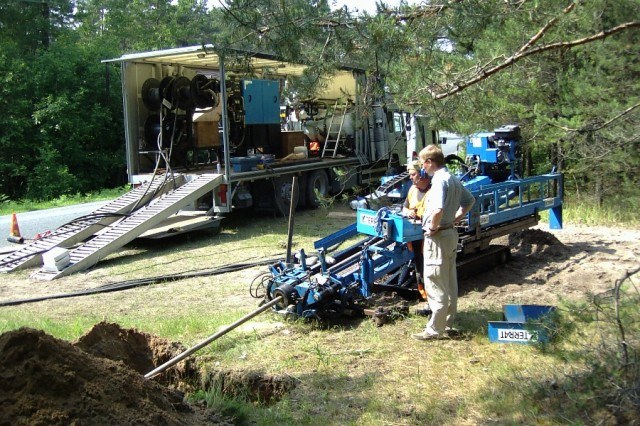
The Grundodrill method is used to build and renovate water pipelines, pressure sewers, gas pipelines and telecommunications ducts.
Directional drilling is a method for installing and renewing water pipelines, pressure sewers, gas pipelines and telecommunications ducts.
How the method works
In most cases, directional drilling is a two-stage process. The first stage is pilot drilling: the drill head and drill rods travel from the entry point to the exit point along the design centreline of the pipeline. In the second stage, the pilot bore is enlarged to the desired diameter so that a pipe of the required size can be installed in it.
During pilot drilling, bentonite is pumped through the central channel of the drill rods to the drill head. Jets of bentonite slurry emerging from the nozzles cut the soil and allow the soil particles to be removed by flushing them to the surface, where they settle in a collection tank. The drilling direction can be changed by turning the head down, up, right or left as required.
Pilot drilling is monitored with a special locator. Data from the sensor in the drill head is transmitted by radio signal to the locator display on the surface, where the computer and the operator interpret and record the incoming information.
The bore is always reamed to a diameter approximately 30% larger than the pipe being pulled in. For example, a DN110 pipe requires a 150 mm hole in the ground.
At the exit point, the pilot drill head is removed and a reamer is attached to enlarge the pilot bore to the required diameter. The rotating reamer is fixed to the drill rods, which are simultaneously pulled back along the pilot bore towards the drilling rig. The new pipeline is connected behind the reamer and pulled in during the same operation. Bentonite pumped through the channel inside the rods carries the soil particles to the surface.
Before the pipe itself is pulled in, the pipeline has to be joined into a continuous string by butt welding. The welded pipe is then connected to a pulling head, which in turn is attached to the drill rods. After that, the pipeline is pulled into position through the enlarged bore.
AS Terrat’s drilling team has received thorough, certified training from the equipment manufacturer Tracto-Technik GmbH in Germany.
Key parameters
1. The pipe being installed must have a smooth outer surface to reduce friction and drag when the pipeline is pulled in. PE pipes are preferred for water and sewer pipelines.
2. Directional drilling can be used to install pipes in sizes from 25 mm to 1000 mm. Several pipes can also be pulled in at once by bundling them together. The installation process is the same whether one pipe or several are installed. AS Terrat owns Grundodrill 10S and DWJT 3020 directional drilling rigs, which can install pipes up to 450 mm in diameter and, depending on the diameter and ground conditions, in lengths of up to 200 linear metres.
3. Based on international experience, a single drilled section can be 120 m or longer – up to 1800 m – depending on the ground conditions and the drilling rig used.
4. Geological information on the soils is needed both for design and for the drilling itself. Pulling force and pressure must be monitored carefully. Ground conditions are of great importance in every drilling operation of this kind.
5. Directional drilling does not necessarily require launch and reception pits. There must be enough space at the drilling site to weld the pipeline together and align it with the drilling line.
6. Directional drilling technology is relatively complex and therefore requires an experienced operator. The operator must be knowledgeable about drilling, the effects of drilling on different geological strata, reading and recording instrument data, interpreting computer printouts, etc.
7. The accuracy of the installation depends on the measuring system used and the skill of the operator. That said, deviations have generally been more than 4% of the total length.
Have a question or need a quote? We're happy to help!